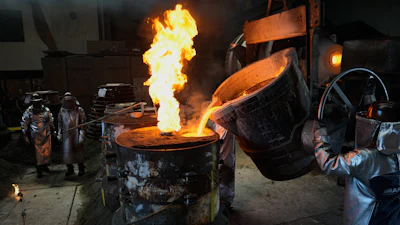
INNSBRUCK, Austria (AP) — Wearing protective gear to shield from the extreme heat of molten bronze, workers at one of the last bell foundries in Europe are casting bells weighing several tons.
One after another, the artisans carefully pour the molten metal into specially shaped molds held together with steel bands to create 12 bells for churches in Italy, Germany and Romania.
Founded in 1599, the Grassmayr Bell Foundry, in Innsbruck, western Austria, has survived wars, famines, epidemics and economic challenges.
These days, the family business is run by brothers Johannes and Peter Grassmayr. During the Renaissance in the late Middle Ages, there were hundreds of bell makers in Europe, while today only a handful remain across the continent.
The Grassmayrs' secret to success: tenacity combined with innovation, such as 3D printing, scanning, lasers and computer simulation apps.
"Certain things are just like they were 400 years ago. But we innovated a lot. Especially within the last 20 years, we've changed a lot," Johannes Grassmayr told The Associated Press.
The production cycle for making a bell takes three to four months. In the past, cleaning a freshly cast bell and polishing it made up 30% of total production time. Nowadays, with the help of modern tools, that process takes only a tenth of the time.
Grassmayr keeps some of its most innovative production steps a secret, such as a special chamber where the bells are cleaned with a high-pressure sandblaster, not to mention the specialized apps used to calculate the sound of each particular bell.
Even with modern technology, the process of designing and forming the molds for a large bell can take up to six months.
"The important thing is that you have calculate, form and then cast the bell as a musical instrument." Johannes said, adding that the greatest difficulty in creating the bell is the risk that molten metal pressure will destroy the mold.
When the workers cast a large bell weighing several tons, the liquid bronze creates up to 125 metric tons (137 tons) of pressure inside the molds, he said. To ensure the integrity of the mold, only high-quality clay is used and then encased in steel sleeves designed to withstand extreme pressure.
But it's not only the difficulty of the production that has Grassmayr worried. The modern bell-making industry is under pressure as fewer churches are being built, changing the demand for bells. Rising energy costs due to the war in Ukraine are not helping, and labor costs have risen 30% since the pandemic in 2020.
But the main cost factor of a newly cast bell is still the price of materials. The best bells require high-quality bronze, which is 80 parts copper to 20 parts tin. A few years ago, the price of bronze was 8 euros ($9.23) per kilogram compared with 23 euros ($26.17) today, Johannes said.
"That's why I can't even say how much a bell is going to cost in a year. I just hope the metal price is going to come down again," he added.
To keep the business going, the family has increasingly turned to restoring old bells, often with the help of modern technologies. Hundreds of defective bells from 12 European countries have been restored at the Grassmayr bell foundry, according to the company.
Bells made by Grassmayr can be found in over 100 countries, ranging from Japan to the United States.
One of the largest the brothers have cast was for Romania's National Cathedral in Bucharest. Cast in 2016, it is 3.3 meters (10.8 feet) tall and weighs more than 25 metric tons (27.5 tons). Another creation, weighing 15 metric tons (16.5 tons), hangs in a church on Mount Tabor in Israel.
Johannes showed the AP several recently cast bells that were being left to cool down for a week before being removed from their molds. He pointed to the precise negative imprint still visible in the clay form.
"This bell is for the church in Zethau, in Germany," he said. "I'm very happy with the casting. I'm especially happy that the innovations of the past decades helped a lot to make the bells ever more beautiful and better."