U.S. markets rose in premarket trading Thursday, taking back much of their losses from a day earlier that were driven by speculation that the Federal Reserve may raise interest rates this year to try and reign in persistent inflation.
Futures for the S&P 500 rose 0.6%, while futures for the Dow Jones Industrial Average edged up 0.2%. The Nasdaq was on track to claw back all of its losses from Wednesday, with futures gaining 1.3% before the opening bell.
Oil prices continued their charge downward after the U.S. and Iran signed their initial agreement ending the war.
The price for a barrel of Brent crude oil fell $1.19 to $78.36. It's still above its roughly $70 price from before the war, but it's well below its $100-plus price from a few weeks ago.
U.S. benchmark crude slipped $1.56 to $74.45 per barrel.
The U.S.-Iran agreement starts a 60-day negotiating clock to reach a final deal on the future of Iran's nuclear program. In the meantime, it calls for Tehran to dilute its stockpile of highly enriched uranium.
The deal waives U.S.-backed sanctions on the country, immediately allowing Iran to sell its oil freely in a major concession from Washington, according to details released by both countries.
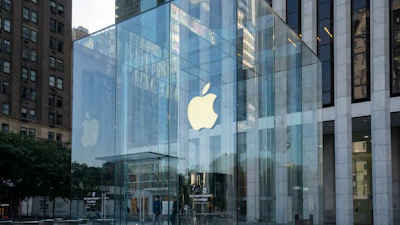
In equities trading, Intel soared another 8.7% after U.S. President Donald Trump announced in a social media post that the semiconductor giant had agreed to make chips for Apple in the U.S. That announcement came after media reports that Apple was planning to raise prices due to a shortage of memory chips.
SpaceX was falling for the second straight day since its ballyhooed debut on the U.S. stock market last week. The Elon Musk-led rocket maker and AI company was down 3.2% before the bell Thursday following a 4.9% loss Wednesday.
Thanks to falling oil prices, travel-related companies continued to rise. Delta, United and American all rose between 1.5% and 2%. Cruise lines Royal Caribbean and Carnival were both up more than 2%.
In his first news conference as head of the U.S. central bank, Kevin Warsh, did not give a forecast for where the federal funds rate may end 2026. He said he's considering a revamp of how the Fed communicates with financial markets and U.S. households and businesses.
One of his first moves was to end the inclusion of hints in Fed statements about where interest rates may be heading in the future.
However, nine of Warsh's 18 colleagues on the Fed's rate-setting committee signaled they supported higher rates this year, with six supporting two or more quarter-point increases.
Higher interest rates can tap the brakes on inflation, but they also slow the economy and hurt prices for investments. For much of the past year, the expectation has been that the Fed would be cutting rates.
Elsewhere, in Europe at midday, Germany's DAX edged 0.1% lower, while the CAC 40 in Paris ticked down 0.2%. Britain's FTSE 100 shed 1%.
During Asian trading, Tokyo's Nikkei 225 resumed its climb, gaining 1.7% to a new closing high of 71,053.49. It topped 70,000 for the first time this week and is still gaining thanks to hopes for an end to the war and strong buying of high-tech shares due to the artificial intelligence boom.
"This is very broad-based rally, I believe it's actually showing some confidence that the Japanese economy is going to recover further from the ... the end of the war, and presumably the oil prices in the near future," said Neil Newman, head of strategy at Astris Advisory Japan.
South Korea likewise has been setting records, gaining 2.3% to 9,063.84. The Kospi has roughly tripled in the past year, helped by gains for computer chipmakers Samsung Electronics and SK Hynix. Samsung's shares rose 4.6% and those of SK Hynix gained 6.5%.
Taiwan's Taiex jumped 1.3%.
In Hong Kong, the Hang Seng lost 2.1% to 23,792.35, while the Shanghai Composite index edged 0.4% lower to 4,090.48.
Australia's S&P/ASX 200 slipped 0.6% to 8,911.10.
Senior Producer Mayuko Ono contributed to this report.