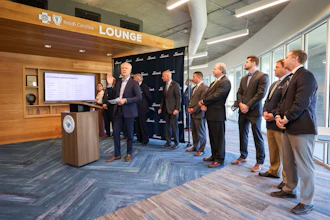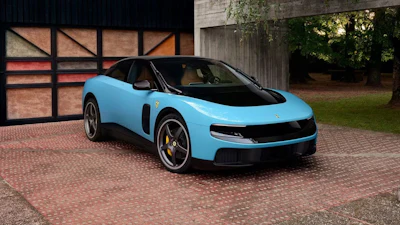
Ferrari unveiled the Ferrari Luce, a fully electric car, at the Vela di Calatrava – Città dello Sport in Rome, a venue chosen to mark the beginning of a new chapter in Ferrari's history. The automaker revealed next-generation sports car from the Maranello marque to the President of the Italian Republic, Sergio Mattarella, at the Quirinale Palace.
The Ferrari Luce marks the culmination of Maranello’s multi-energy strategy, announced at the 2022 Capital Markets Day. The company said deepening its in-house expertise in electric technology opens new potential for performance and efficiency across its ecosystem.
Ferrari chose to engineer, develop and manufacture the Luce's main components in Maranello, with the project including more than 60 new patents. However, Ferrari entrusted the Luce's design to LoveFrom, the collective led by Jony Ive and Marc Newson.
An electric power source affords a new architecture that combines Ferrari performance with spaciousness. This architecture accommodates four doors and five seats, a first for the Prancing Horse as transaxle configurations with a front-mid engine and a rear gearbox do not allow for a fifth seat.
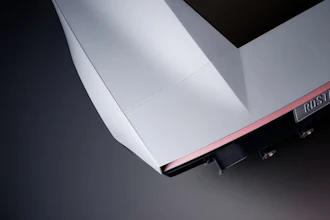
The vehicle also features a glass house, a shell-like form that extends below the belt line to the extremes of the car. The front and rear aerodynamic wings float above and around the silhouette of the glass house.
The front and rear light panels are transparent and part of the primary surfaces. The lights seem to gently recede when switched off, with the halo tail lights paying tribute to the 360 Modena and 458 Italia.
Additionally, the Luce offers the largest staggered wheel diameters on a series-production Ferrari road car with 23 inches in the front and 24 inches at the rear.
The interface groups controls and displays to place the most essential commands and feedback directly in front of the driver. Precision-engineered mechanical buttons, dials, toggles and switches are combined with multifunctional digital displays developed with Samsung Display. Materials include recycled anodized aluminum, Corning Gorilla Glass and premium leather, while the audio system has 21 speakers and 24 channel/3000 W amplification.
Ferrari managed to contain curb weight at 2260 kg to deliver 0–100 km/h in 2.5 seconds, 0–200 km/h in 6.8 seconds, a top speed of over 310 km/h, a maximum total power output of 1050 cv and a range in excess of 530 km.
The car is powered by four electric engines, one per wheel, and is equipped with a 122 kWh battery, an active suspension system derived from the F80 and an independently steering rear axle.
Each wheel is equipped with one actuator for traction and regeneration, one for the steering angle and one to control vertical movement. Each of the Ferrari Luce’s wheels is therefore attuned to the driver’s input. Torque vectoring and the elastic balance of the suspension system also assist in changing direction.
The vehicle's approach to sound includes a precision accelerometer at the center of the axle that captures the dynamic texture and vibration of the rotating components while the sound waves are moving. Developed in-house and patented, this system filters, equalizes and amplifies the signal in a similar way to an electric guitar, but only when functional to the driving experience.
The sound level is based on the position of the e-Manettino and the use of the paddles, allowing the driver to switch from quiet focus to maximum expressiveness. Sound is emitted via an external amplification system that creates a natural sound wave and an internal system that ensures detail and high fidelity.
Addressing aerodynamics, Ferrari refined surfaces to be smooth, continuous and uninterrupted to maximize airflow and wake management. The active aerodynamic grilles regulate the airflow through the heat exchangers and ensure the correct balance between cooling requirements and aerodynamic drag.
Active ride height can lower the front by 10 mm at speed to maximize efficiency without compromising comfort or performance. The cooling system is part of an integrated software that optimizes range by balancing power consumption and intelligent warm-up, fast-charging management and battery and cabin preconditioning functions, operable remotely.
The driver manages the car via the e-Manettino, which modulates power and traction, and the five-position Manettino equipped with logics that adapt to grip conditions. The Vehicle Control Unit (VCU) makes its debut on the Ferrari Luce, which integrates powertrain and dynamics, updating targets 200 times per second and coordinating efficiency strategies with the brand-new Side Slip Control X.
The electric all-wheel drive is a first for a Ferrari. It allows the full potential of torque vectoring to always make the car precise and responsive, while the new torque shift engagement and extended regenerative braking deliver a progression of torque and engine braking worthy of a sports car. Ferrari has engineered a proprietary, patented system that allows the available torque to be increased by operating the right-hand steering wheel paddle, while maintaining the sensation of progressive acceleration. The left paddle increases energy recovery and the sensation of deceleration.
The powertrain comprises four F80-derived permanent magnet synchronous engines with radial flux, delivering a maximum speed of 30,000 rpm at the front and 25,500 rpm at the rear. The system operates on 800 V architecture and combines performance with efficiency, with solutions directly derived from motorsport. The high-voltage battery pack was designed, validated and built in Maranello and comprises 210 cells in series that deliver 122 kWh and support fast charging up to 350 kW. Power electronics feature compact inverters and a DC/DC resonant converter for the active suspension to achieve efficiency of more than 98%.
The battery housing actively contributes to rigidity, with an increase of over 25% (bending) and 35% (torsional) compared to previous four-door models. The BIW-battery housing combination is among the lightest in its class for a vehicle of this specification. The semi-virtual double wishbone suspension, with a high-mounted upper arm, independent rear-wheel steering, CCM brakes and targeted solutions to reduce friction, complete a set-up designed to maximize driving excitement and comfort.
The use of recycled secondary-alloy aluminum reportedly allows a reduction in CO₂e emissions during production of around 70% of the overall vehicle weight.