End-users face an important decision when their equipment needs servicing, one that directly impacts downtime and future productivity: they can attempt to service it themselves, hire a third-party provider or contact the original equipment manufacturer. Ultimately, each end-user has to make the decision that’s right for their company. Still, as technology continues to advance, the benefits of establishing a trusted, direct relationship between an OEM and an end user are becoming even clearer and they’re often a signature of successful, sustained manufacturing operations.
Knowledge Gap
The relationship between OEM and end-user often starts with the initial purchase - the customer has a need, and the OEM supplier has technology to solve it. Too often, though, once the purchase is completed, that’s where it terminates. Some end-users see it as strictly transactional, and aren’t interested in an extended relationship once the technology is installed and their processes are up and running. This is a risky approach to take, especially if the end-user is integrating newer technology with legacy infrastructure. There will inevitably be tweaks that need to be made, and without a trusted OEM partner to help, end-users can make errors that impact productivity.
When those issues do arise, or the technology needs to be serviced, end-users that don’t have a direct relationship with the OEM will often seek a third-party service provider. Outcomes with these repair shops can vary greatly, as many of them don’t have the innate knowledge about a piece of hardware or its life cycle within the end-user’s setting or application. They will attempt to fix the problem as best they can, but often it’s without valuable background knowledge of the part or subassembly, and the result is a makeshift solution that may not be sustainable for extended operation.
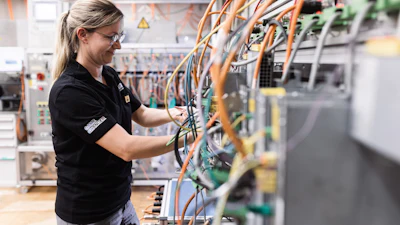
Comparatively, original part manufacturers have direct knowledge not only of the part or unit itself but also of its evolution and the intricacies of its integration with various systems. Controls, drives and motors are great examples of this, as they play such a central role in manufacturing. Their evolution in recent years toward a more open, digitized infrastructure with apps, along with key hardware advancements like a cabinet-free design for drives, results in an extensive product marketplace that may be difficult for third-party service providers to keep up with. This gap expands when considering the predictive maintenance possibilities that some newer technology promises. If a third-party service provider doesn’t know how a product serves the end-user’s needs not just through productivity but in alerting them when there are operational anomalies through software integration, then the end-user is at a disadvantage and may not be experiencing all the benefits that the technology can provide.
 Bosch Rexroth
One Step At a Time
Making the transition to a more modern footprint can be daunting to some, and each end-user is navigating it at their own pace. But a key aspect to consider is how to do it with servicing in mind. While it may be tempting to make wholesale changes and install an entirely new line, there can be risks in doing so. It often requires more money, downtime and debugging to work through such a large overhaul, which can put a strain on end-users that are up against customer demands.
Consulting with a trusted OEM supplier directly on a strategic, piecemeal approach to upgrading is often the better way to go. Isolating that transition to one component or section at a time builds a foundation of productivity and integration and allows the end-user and supplier to see how each upgrade fits into their system. If there are any issues with a component, the entire line won’t be as affected as much as if there were multiple components being upgraded at once. This approach also reveals which components truly need to be replaced versus which ones simply need to be serviced or retrofitted. That can save end-users money and valuable downtime.
Finally, upgrading incrementally helps the OEM supplier gain more knowledge of the end-user’s processes, which ultimately helps future servicing since the supplier has been with the end-user since the beginning.
Understandably, some end-users are hanging on to their legacy products as long as possible. They want to avoid the expense of replacing it, and if productivity isn’t suffering, they don’t feel it’s necessary. An important point to remember is that, especially for solutions that are more than 20 years old, the number of knowledgeable third-party service providers for that technology is decreasing.
If the end-user doesn’t have an established relationship with that original equipment manufacturer, it can be time-consuming to find a provider that has the knowledge to service it and costly to have them do so. That’s why it’s important for end-users to constantly be evaluating the true cost of ownership of their solutions. If any of their processes need to be serviced or replaced, they need to consider what the impact to the company would be, both in productivity lost and in the investment in time and money.
Just like purchasing mentioned earlier, servicing isn’t meant to be transactional – it’s consultative. Like a trusted family doctor, an OEM supplier who knows the ins and outs of their product and the history of the end-user’s processes serves as a valuable asset to ensuring productivity. They can diagnose issues faster than a third-party provider, advise on the correct course of action and assist in the transition to a more modern footprint. This is especially helpful for end-users in a greenfield operation that are starting fresh. But regardless of the environment, end-users need to maintain a relationship with a trusted service provider that has direct knowledge of their solutions, as the benefits have a direct impact on future operations.
About the Author
 John Gaddum