Pumps are critical assets in all industries, including oil & gas, chemical processing, power generation, water treatment and more. When a pump fails, the impact is immediate: lost production, emergency repairs and safety risks. In facilities worldwide, a single unplanned outage can cost hundreds of thousands of dollars in just hours.
To help mitigate these losses, facilities are integrating thermal imaging into their preventive maintenance routines. Aligning with internationally recognized ISO standards, thermal imaging is a technology that provides early warning of developing faults, making it a technically reliable and financially compelling investment.
 Figure 2. This product transfer pump is integral to moving a food production line. Thermal imaging is used to identify uniform heat distribution, which is crucial for product flow. It can also highlight potential seal leaks, blockages or mechanical stress, allowing for proactive maintenance. Motion
Common issues detectable via thermal inspections include:
- Overheating of bearings caused by improper lubrication practices, wear or manufacturer defects.
- Shaft misalignment or imbalance due to heavy use or improper installation, visible as a heating gradient across the shaft and couplings.
- Seal degradation that produces localized hot spots leading to critical failures.
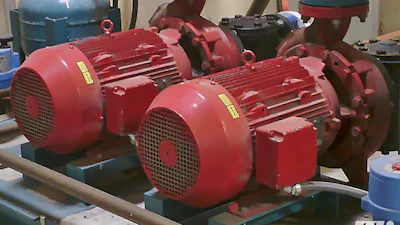
- Electrical motor faults, including winding issues and overloaded connections (Figure 1).
- Restrictions in hydraulic systems, where uneven casing temperatures reveal cavitation or blockages.
The financial argument for thermal imaging is straightforward ROI: One avoided failure often pays for the entire program.
Example 1: Bearing failure
- Without Thermal Imaging: A process pump bearing overheats undetected, seizes and causes catastrophic shaft damage. Emergency repairs require a crane lift, expedited parts shipping and two days of lost production. Estimated cost: $75,000–$100,000.
- With Thermal Imaging: A routine scan detects a bearing running 20ºC (68ºF) above baseline (classified as an actionable fault in ISO 18434-1). Maintenance schedules a bearing change during planned downtime. Total cost: $2,500.
 Motion
Example 2: Motor electrical fault
- Without Thermal Imaging: Loose electrical connections inside a motor junction box cause overheating and eventually trip the motor. Restarting the system delays production operations for half a shift. Downtime and repair cost: $25,000+.
- With Thermal Imaging: Hot spots are identified during inspection, and the connection is tightened in under an hour. Total cost: <$500.
Across industries, companies report up to a 30% reduction in maintenance costs through thermography inspections, along with fewer breakdowns and a drop of over 60% in pump-related failures. ROI is quickly achieved with the cost of the thermal imaging program recovered after preventing just one major failure.
Another key advantage of thermal imaging is its definition within global ISO and NFPA 70B standards, providing organizations that follow these standards confidence in their consistency, efficiency and accuracy.
- ISO 18434-1:2008 – Condition monitoring and diagnostics of machines – Thermography – Part 1: General procedures. Provides guidance for thermographic monitoring of rotating equipment such as pumps, valves and all electrically powered machines.
- ISO 17359:2018 – Condition monitoring and diagnostics of machines – General guidelines. Recommends thermography as part of a comprehensive predictive maintenance strategy.
- ISO 13306: 2017 – Maintenance terminology. Ensures consistent reporting and communication of findings.
 Motion
By referencing these standards, organizations strengthen their reliability programs and demonstrate compliance with internationally accepted best practices, which are critical during audits and client reviews.
Within an effective reliability program, a structured thermography process typically includes:
- Baseline Imaging – Recording images and thermal profiles under normal operating conditions.
- Routine Inspections – Conducting monthly or quarterly scans based on the pump’s criticality to the process.
- Trend Analysis – Comparing current data to a previously established baseline while applying ISO standards to classify the severity of any discovered issues.
- Corrective Action/Repair – Creating detailed work orders through a CMMS system to schedule repairs or solutions.
- Verification – Using thermal imaging to confirm that the discovered issue has been resolved.
Thermal imaging inspections, combined with vibration analysis and lubricant testing, enhance predictive accuracy, delivering comprehensive views of the pump’s health (Figure 2). When deployed correctly, thermal imaging becomes more than a diagnostic tool—it becomes a risk management service that directly protects a facility’s profitability.
Of all of thermography’s benefits, the most important is safety. Utilizing this non-invasive technology reduces exposure to hazardous environments and prevents accidents before they occur. Many end users consistently report safety as the primary reason for investing in thermal imaging technologies, underscoring the critical role these tools play in protecting both personnel and equipment.
For decision makers, the value proposition is clear: Investing in thermal imaging is effectively an insurance policy against six-figure failures and safety liabilities. For manufacturers and other facilities, it’s a powerful asset that combines technical credibility with measurable ROI.
Using an “extra sense” to detect heat before it becomes a failure isn’t just smart—it’s a boost to uptime and the bottom line.
Ryan Boyle is an on-site solutions specialist at Motion with 10 years of industry experience. He enjoys applying his predictive/preventive maintenance technology expertise to help customers optimize their facilities.
For more information, visit motion.com.