New technology that invites expressive, two-way communication between a person and the soft, flexible object they are holding or wearing has been developed at the University of Bath.
Using this system, a user can tap, twist or pinch a soft object – such as a cushion, an item of clothing or a pliable computer mouse – and the object will respond in a meaningful way, for instance, by changing the TV channel, turning off a light or creating a digital sculpture on a screen.
Crucially, the object also provides tactile feedback (such as a soft click or vibration) to confirm the action, while maintaining its natural softness and flexibility.
Jason Alexander, who leads the research in HydroHaptics in the Department of Computer Science at Bath, said, “Input from the user is sensed by the system through the object and the user then feels the system’s haptic response through the deformable surface."
The development of HydroHaptics opens up promising opportunities for intuitive, touch-based interactions with everyday items. Wearable tech, gaming, product design and medical simulation are just a few of the fields poised to benefit.
The researchers demonstrated the potential of HydroHaptics by integrating it into four everyday products: a cushion, a backpack, a deformable computer mouse and a deformable joystick.
- Cushion: A small, HydroHaptic pouch was inserted into a cushion. Pressing or squeezing the cushion controlled smart home devices.
- Joystick: A deformable, 3D joystick was enriched with HydroHaptic technology to give players haptic feedback during gameplay to simulate resistance, tension or sharp impact.
- Backpack: An augmented backpack delivered smart phone notifications through shoulder taps and presses. These tactile cues can also be used for navigation.
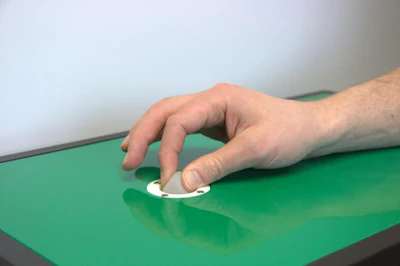
- Computer mouse: An augmented mouse with a soft, silicone dome allowed users to sculpt digital objects on a screen through the actions of pressing and deforming the mouse surface. Dynamic feedback simulated the material’s stiffness and guided the sculpting process.
Professor Jason Alexander said, “With this technology, we can include high-quality haptic feedback in soft deformable objects and interfaces for the first time – we see huge potential for this technology across a wide range of interactive devices. Our experiments show this is a reliable system for allowing a human to interact with soft objects in a meaningful way that will enhance the way we live and work.”
HydroHaptics is the first technology to deliver high-fidelity haptic output through a deformable surface without compromising the surface’s softness, flexibility, or input richness.
Bath Computer Science PhD student James Nash, said, “In other words, the surface remains soft and flexible no matter how you press, twist or pinch it – something that, until now, simply hasn’t been possible."
HydroHaptics is powered by a compact motor and uses a sealed liquid-filled chamber to transmit haptic forces between the motor and the user. It is this setup that allows users to feel sharp clicks, vibrations and varying resistance while the surface remains soft and pliable.
Other research teams working on soft, deformable interfaces have produced prototypes that show varying degrees of low-fidelity feedback (i.e. feedback that is less detailed, less precise or less realistic) or highly localized sensations (i.e. limited to tiny dots on a fingertip) but none have achieved the resolution, precision and scale demonstrated by HydroHaptics.
HydroHaptics products have the potential to be market-ready in the near future. But first, scientists will need to refine the haptic engine to reduce its bulk and make it suitable for commercial applications.