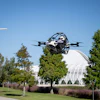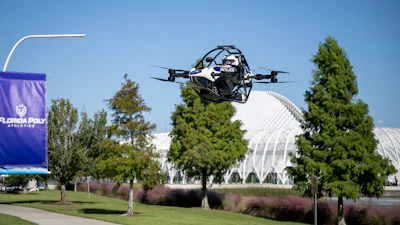
The Florida Polytechnic University Police Department said it has become the first law enforcement agency in the nation to integrate an electric vertical takeoff and landing (eVTOL) vehicle into its operations.
The manned aircraft is dubbed Astro in a double nod to science and the dog from the classic Jetsons cartoon.
"Advanced air mobility is a technology on the rise, and we can either choose to be proactive or reactive as it develops," said Aaron Murray, the University's police chief, in a statement. "We want to stay at the forefront of this technology and understand how it can be used to advance public safety and airspace safety altogether."
Florida Poly is in the final stages of seeking approval from the Federal Aviation Administration (FAA) to use the aerial patrol vehicle in its operations. Murray said Astro can enhance the department's ability to monitor campus and surrounding acres, reach areas difficult to access by traditional vehicles, assist with post-storm recovery efforts and deliver emergency supplies quickly when needed.
The University Police plans to collaborate with law enforcement agencies throughout the region to deploy Astro in support of emergency response and other public safety operations.
Stéphan D'haene, CEO of Jetson, said the California-based company fast-tracked Florida Poly's order of the Jetson ONE vehicle despite a three-year waiting list because of the University's STEM focus and the police department's public safety purpose.
"In our business plan and in alignment with our mission, we have always been looking for the use case beyond the recreational intent," said D'haene in a statement. "We believe that this project is so important and aligns so much with what we want to do that we made it a priority."
Beyond its public safety applications, Astro will become a hands-on learning and research tool for Florida Poly students and faculty. The University launched its new aerospace engineering degree this fall, providing students an immediate opportunity to study emerging flight technology in a real-world setting.
"At Florida Poly, we want our students working with emerging technologies before they become commonplace," said Dr. Brad Thiessen, Florida Poly's provost. "Astro gives our students and faculty a living laboratory where they can analyze real-world data, tackle new engineering challenges and help shape the future of advanced air mobility."
Faculty and students are already coordinating efforts to use real-time operational data from Astro for academic research and senior capstone design projects.
"Connecting an educational component to this technology is a big deal," Murray said. "We are a technology university, and this aerial vehicle delivers more opportunities to learn, build partnerships and explore ways to keep our airspace safe, while connecting the work of our police department directly with our students."