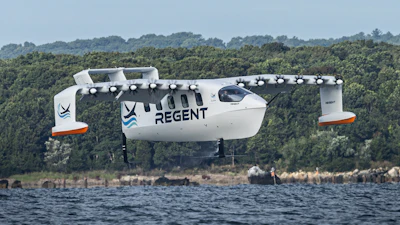
Regent Craft said its Seaglider vessel prototype has successfully completed its first human-crewed flight, making it the largest-ever all-electric wing-in-ground effect (WIG) craft to fly with people on board.
It's starting out small: it only had two crew members aboard and flew just 1,956 feet at 33 feet above the water for 30 seconds. But the prototype flight test provides critical validation of the innovative technology and marks the start of the program's final stage of sea trials.
The vessel operates in three modes — float, foil, and fly — starting on its hull at low speed, transitioning to hydrofoils once clear of the dock, and then taking flight within one wingspan of the water's surface. The company said it will eventually be able to fly at speeds up to 180 mph for up to 180 miles, and seat 12 passengers and two crew. It will provide passengers with plenty of legroom, large windows and a quiet ride — all while traveling faster than a ferry and skipping the delays of airport-style check-in.
The vessel, dubbed the Viceroy, is being developed for commercial and defense applications. Earlier this year, Regent announced that The Twenty Five, a luxury coastal travel operator and membership platform, will be its first domestic delivery and U.S. launch partner for Seaglider operations in the Northeast and Southeast U.S., with an order for up to 60 Viceroy Seagliders. The company also has a $15 million contract with the U.S. Marine Corps Warfighting Lab and a cooperative research and development agreement with U.S. Special Operations Command (USSOCOM). The company’s autonomous Seaglider drone, Squire, completed its first defense-specific wing-in-ground effect flight earlier this year.
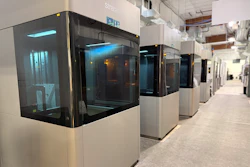
In June, Regent completed construction of the world's first Seaglider manufacturing facility, a 255,000-square-foot site at its Quonset, Rhode Island headquarters that is coming online this year as the global production hub for the company's order book. The facility will house structural assembly, wing and hydrofoil integration, battery and systems installation, and water-based testing, with direct waterfront access for sea trials and proximity to Rhode Island's maritime manufacturing workforce.
Built to scale in phases, the site will handle end-to-end production of the 12-passenger Viceroy vessel and the Squire drone.