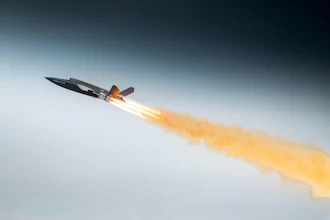
Anduril and Archer Aviation today unveiled their jointly-developed autonomous VTOL aircraft platform, built to serve both defense and commercial applications. Anduril showcased the defense variant, Thunder, a Group 5 autonomous attack rotorcraft.
The companies said they have built what they believe to be a step change in vertical lift: a new class of autonomous aircraft with the speed, range, payload and operating cost that defense and commercial missions demand. Archer will announce its first commercial partners for the platform later this week.
Thunder builds on a dual-use platform developed by Archer and Anduril, bringing the commercial VTOL sector's rapid innovation in electric propulsion and rotor design directly into a clean sheet configuration.
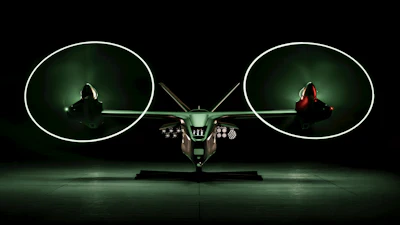
A series hybrid-electric powertrain enables the aircraft to achieve significant range and endurance, while still maintaining the necessary precision to closely optimize power through the full range of flight conditions. Meanwhile, dual tiltrotors vary rotor RPM to maintain efficiency across flight regimes, reducing power demand and fuel burn in cruise and minimizing acoustic signature to enhance survivability during low-altitude ingress.
 Anduril/Archer
The platform’s tiltrotor configuration combines vertical takeoff and landing (VTOL) with efficient wingborne cruise, enabling runway-independent operations from austere locations without the range constraints of traditional rotorcraft.
Anduril and Archer have configured the dual-use platform to bring modular, heavy payloads to an array of commercial and defense applications. It leverages years of development and flight testing on air taxis, highlighting Archer’s proven ability to rapidly design, manufacture and fly advanced VTOL aircraft platforms.
The team has already completed multiple test flights with full-scale surrogate aircraft, a critical step towards proving out the systems that will be central to Thunder’s performance. Thunder’s first flight is planned for 2027.