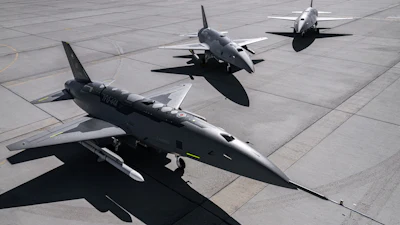
Anduril and General Atomics Aeronautical Systems have both been awarded new production contracts from the U.S. Air Force for unmanned aircraft as part of the Collaborative Combat Aircraft (CCA) program.
Under the contract, Anduril will deliver an initial set of production FQ-44 semi-autonomous fighter aircraft to support continued testing, validation and operational fielding. The contract also establishes a structure for the Air Force to buy additional lots of production FQ-44 aircraft across the next several years.
Anduril was given a prototype award in April 2024, started ground testing in April 2025, recorded first flight in October 2025 and has now secured a production contract. The company said it represents the fastest path from prototype to production for a fighter aircraft in more than 50 years.
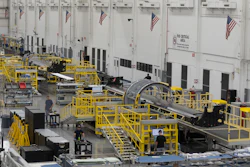
The production line at Arsenal-1 is capable of delivering up to 150 aircraft per year in its current configuration.
"Everything on that line is on wheels, ensuring that we can iterate on our production system in parallel with iterations on the aircraft itself, or scale it further to meet additional surges in demand," the company said.
 General Atomics
At the same time, General Atomics has received a production contract for the FQ-42A Collaborative Combat Aircraft (CCA).
“This is an exciting day for our company and the nation,” said General Atomics President David R. Alexander in a statement. “Moving to production on FQ-42A is the result of an extraordinary partnership and many years of investments between General Atomics and the U.S. Air Force. We’ve been preparing for this order, and manufacturing is already well underway.”
The FQ-42A is an uncrewed fighter developed as part of ongoing investment in next-generation semi-autonomous combat aircraft. The aircraft’s modular design enables integration of mission systems and mission autonomy software. GA-ASI’s software architecture, demonstrated through live flight tests on multiple airframes, provides the foundation for human-machine teaming in complex combat scenarios.
The development effort by GA-ASI fast-tracked, with the aircraft moving from contract award to first flight in just 15 months.