MOUNTAIN VIEW, Calif. - Muon Space, a leading end‑to‑end space systems provider specializing in mission‑optimized satellite constellations, today announced an agreement with SpaceX's Starlink to integrate its mini laser terminals into Muon's high-performance Halo satellite platform.
Starlink's mini lasers are designed to achieve link speeds of 25 Gbps at distances up to 4,000 km (and are capable of higher link speeds at shorter distances). By connecting to Starlink's global satellite network, Muon will offer customers persistent, real-time access to their satellite constellations and data on-orbit — eliminating the latency associated with traditional ground networks and enabling real‑time tasking, payload operations, and ultra-high bandwidth data streaming to anywhere on Earth.
This agreement integrates Muon's satellites into Starlink's global digital infrastructure, delivering critical insights and services, and opening new business models where constellations operate with the same Internet speed and responsiveness as cloud providers and telecom networks on the ground.
Pascal Stang, CTO of Muon Space, said, "This is a sea change in how space systems operate. With persistent optical broadband, Muon Halo satellites will move from being isolated vehicles to becoming active, real‑time nodes on Starlink's global network. That shift transforms how missions are designed and how fast insights flow to decision‑makers on Earth."
Michael Nicolls, VP of Starlink Engineering at SpaceX, said, "High-speed, low-latency connectivity on orbit is foundational for modern space missions. By integrating Starlink mini lasers, Muon's spacecraft can remain persistently connected through our in-space laser mesh, enabling real-time tasking, continuous command-and-control, and immediate data delivery to terrestrial points of presence. We're excited to support Muon Space as they bring these capabilities to commercial missions."
Built from the ground up as fully integrated network-connected platforms, Muon's Halo satellites now extend that design globally, ushering in a new era where spacecraft operate as always-on, high-performance nodes in a worldwide data ecosystem.
From intermittent downlinks to persistent connectivity. Traditional ground station architectures provide brief contact windows; Starlink's mini lasers can be easily installed into Muon Halo spacecraft, creating near‑continuous connectivity by routing traffic through SpaceX's in‑orbit optical network to terrestrial Points of Presence (PoPs).
- High throughput. Each terminal supports an optical link up to 25 Gbps (↓↑) at link distances of up to 4,000 km, with latency from orbit to the ground measured in milliseconds.
- Data center–class pipelines. With persistent 25 Gbps backhaul, spacecraft can continuously stream to terrestrial Points of Presence and cloud environments while running in‑orbit edge processing, enabling near‑real‑time data fusion, AI inference, product generation, and closed‑loop tasking – turning each satellite into an extension of a distributed data center.
- Resilience and uptime. A single terminal delivers high availability with brief handover interruptions ("hops") as the link transitions between relay satellites. Multi‑terminal configurations enable "make‑before‑break" handovers for >99% uptime and availability in typical LEO operations.
- Security by design. User traffic traverses Starlink's satellite network in encrypted, mutually‑authenticated tunnels, with hardware‑anchored keys and customer‑controlled end‑to‑end encryption layered on top.
Muon has begun integrating Starlink's mini laser terminals into current customer constellations and will be launching its first Starlink-enabled Halo satellite in Q1 2027.
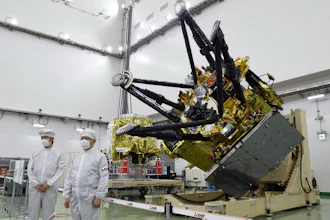
Muon's vertically integrated Halo technology stack – including the MuSat XL (≈500 kg‑class) platform with high‑precision pointing and ample payload capacity – streamlines payload integration and leverages Starlink's optical broadband for rapid data movement and in‑space compute. Together, the stack delivers adaptable payload hosting, accelerated time‑to‑orbit, and next‑generation networking performance.