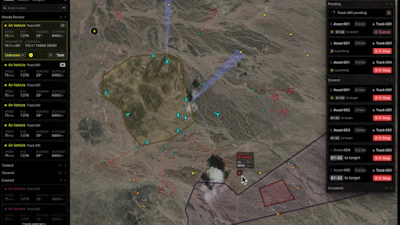
The Army has selected Anduril Industries for the Integrated Battle Command System Maneuver (IBCS-M) program, establishing Lattice as the Army’s next-generation fire control platform for Counter-UAS missions. IBCS-M provides the command, control, and integration backbone for a vast array of counter-drone systems, enabling a single operator to manage multiple threats simultaneously. It fuses sensor data, automates fire control, and integrates new capabilities, reducing operator load and compressing the time from detection to defeat.
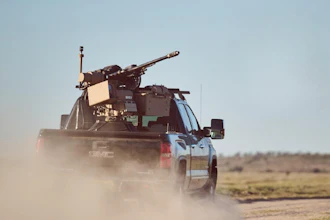
At a recent demonstration at Yuma Proving Grounds, Anduril showcased the power of Lattice — the foundation of IBCS-M. In a seven-day trial, Lattice integrated a previously undisclosed sensor and effector within hours, executed live-fire intercepts that achieved four out of four kills, and demonstrated advanced features like autonomy-enhanced fire control, distributed tracking, and kill-chain optimization.
Alex Miller, CTO of US Army, said, "We can’t think of counter-UAS as static or in the same vein as counter ballistic missile defense. It has to be maneuverable which means it has to be software-centric and adaptable above all else. We can’t wait a year for a new sensor or effector to be integrated and we can’t tell our deployed soldiers that we have to wait for an FSR to solve the problem. It has to support a platoon leader on the move with many small sensors across many vehicles as much as it has to support a forward operating base or garrison commander using a mix of existing and emerging systems."
The IBCS-M effort is part of a broader modernization initiative that is reimagining how the Army commands the fight. Legacy systems were built for an era of predictability — today’s world demands an infrastructure that is open, extensible, and capable of evolving at machine speed.
Matt Steckman, President and Chief Business Officer of Anduril Industries, said, “We’re uniquely positioned to deliver on the Army’s vision because Anduril helped define the new frontier of air defense technology. Our work in autonomous systems and command and control has built the foundation for this moment — it’s a natural extension of the lineage that began when we reimagined how modern defense should operate.”