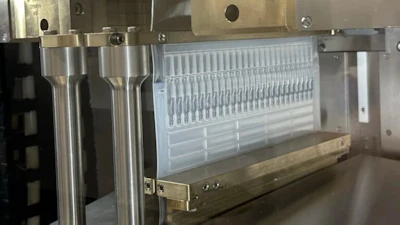
Apiject said it plans to open a new 30,000-square-foot pharmaceutical manufacturing facility in Apex, North Carolina. The facility will house two Blow-Fill-Seal (BFS) production lines and operate as an FDA-registered 503B outsourcing facility focused on producing essential generic injectable medicines currently on the FDA's drug shortage list. The site will also serve as the corporate headquarters of Vanguard Utility, Apiject's operational subsidiary.
The Apex announcement comes after the company recently filed a New Drug Application (NDA) to the FDA for its first BFS-based prefilled injection device.
"America's dependence on foreign sources for essential medicines is a strategic vulnerability," said Jay Walker, Chairman of Apiject. "Reshoring critical manufacturing – from energy and rare earth minerals to pharmaceuticals – is a national priority. This facility represents the next step in Apiject's ongoing work to translate advanced American manufacturing technology into real domestic capacity."
Apiject's manufacturing strategy is built on advanced Blow-Fill-Seal (BFS) technology. Historically, BFS was used primarily in the pharmaceutical industry for eyedrops and inhalation products. With support from the Administration for Strategic Preparedness and Response (ASPR) at the U.S. Department of Health and Human Services, Apiject has pioneered advancements that expand BFS into a standardized, high-speed platform suitable for most liquid injectable medicines.
Unlike traditional glass vial packaging – which relies on complex global supply chains and lengthy production timelines – BFS forms the drug container, fills the medicine, and seals the dose in one continuous automated process. The technology relies on a single, domestically available raw material, eliminating dependence on fragile foreign glass supply chains.
"BFS fundamentally changes the economics of generic injectable drug manufacturing," said Darren Alkins, CEO of Vanguard Utility. "With Apiject's advancements, BFS can now be used for a broad range of liquid injectable medicines, produced quickly, at scale, and at globally competitive costs – right here in the United States for both domestic and international markets."