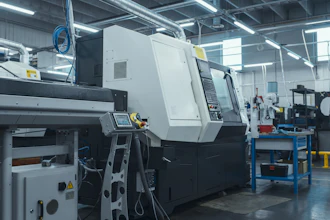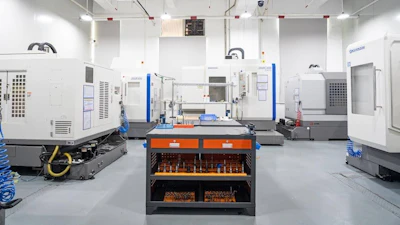
Complex industrial components often combine multiple mounting surfaces, angled holes, deep cavities, and precision locating features. These features are common in parts used for automation equipment, robotics and industrial machinery.
With conventional 3-axis machining, such parts often require multiple setups, part rotations, and realignments.
As the number of setups increases, positional errors between holes, surfaces, and datums can gradually accumulate. However, not every complex part requires a continuous 5-axis CNC machining service to hold its tolerances. WayKen selects 3-axis, 3+2-axis, or continuous 5-axis machining based on part geometry, required tool orientations, and the relationships between critical features.
WayKen Uses 5-Axis Positioning to Machine Related Features From Fewer Setups
For rapid manufacturing, using the fewest set-ups minimizes total re-referencing errors introduced after each re-clamp and re-position of a part. For example, when a mounting bore on one side of a component needs to be positioned such that it will align with an angled hole located on the other side of the component, having both machined from a single 5-axis position greatly reduces the possibility of misalignment due to how accurately the second position was aligned to the first.
The overall purpose of rapid manufacturing of complex industrial geometries is to minimize the number of hand-offs between positions; this directly reduces opportunities for cumulative positioning error to present itself during final assembly. On automation brackets with several mounting faces and angled fastener holes, WayKen has also combined what would have taken three or four separate set-ups into a single 5-axis operation, holding all features to one reference rather than accumulating tolerancing through repositioning.
Tilts the Tool to Improve Access Rigidity and Surface Quality
Tool rigidity depends heavily on how far the cutting edge extends beyond the spindle; the longer that stickout, the more the tool deflects under cutting load, which shows up as chatter marks and inconsistent surface finish. Reaching a feature at the bottom of a deep cavity with a fixed vertical tool axis often forces a long, unsupported tool length just to clear the surrounding walls.
 WayKen Rapid Manufacturing
Tilting the tool axis changes that geometry. By angling the cutter toward the feature instead of reaching straight down past obstructing walls, a 5-axis CNC machining service can often shorten the effective tool length needed to reach the same cutting point, improving both rigidity and the resulting surface finish. This matters most on deep cavities and angled bosses common in industrial housings, where a shorter, stiffer tool path directly reduces the chatter that a longer reach would otherwise introduce.
Selects the Simplest Multi-Axis Process That Can Hold the Required Geometry
Continuous 5-axis machining is not required for all parts with complex geometries. This is because additional costs arise from increased programming time and from using multiple axes simultaneously. Parts that are geometrically flat except for a few angled faces can be machined with similar accuracy using either 3+2-axis machining or indexing to a specific angular location, then cutting with 3-axis machining, rather than using continuous simultaneous motion.
 WayKen Rapid Manufacturing
When WayKen chooses a process, it works backward from the relationships between critical features. When two features must maintain positional relationships to one another but do not require the tool to rotate continuously during machining, 3+2 axis machining can achieve the same rapid manufacturing turnaround at lower cost than continuous 5-axis machining. However, continuous 5-axis is used when a blended surface or curved passage cannot be accessed using stationary angles.
Conclusion
Matching the machining strategy to the part, rather than applying maximum axis capability by default, is what keeps complex industrial components accurate without inflating cost. Choosing between 3-axis, 3+2-axis, and full 5-axis CNC machining based on feature relationships makes that balance possible on a part-by-part basis.