Every time a data center loses power, the financial and reputational consequences ripple outward instantly. For years, the industry has managed that risk with diesel generators, a familiar but increasingly problematic solution. Polluting emissions, air-permitting delays, fuel degradation, and mounting maintenance overhead now collide with stricter environmental regulations and growing community opposition to combustion-based infrastructure.
The industrial operations sector needs fundamentally better onsite energy reserve options, and aluminum-air technology is ready to provide one.
How Aluminum-Air Technology Works
The Aluminum-Air Generator (AAG) generates electricity through an electrochemical reaction between aluminum and oxygen drawn directly from ambient air. The process requires no combustion, no stored oxidizer and no pressurized fuel systems. Aluminum serves as the AAG’s fuel, providing approximately 4 kWh of electricity per kilogram consumed and 10 kWh per liter, giving the system a diesel-like refueling model with an inert, non-flammable solid energy carrier.
During operation, aluminum plates are gradually consumed and replaced through a hot-swap process similar to refueling a conventional generator. When the system enters standby mode, the cells remain chemically inert with no self-discharge. That single characteristic eliminates fuel-related maintenance routines, including fuel polishing and tank monitoring, that diesel operators perform as a standard cost of doing business.
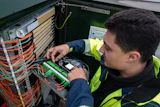
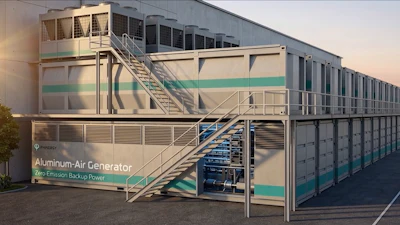
 Aluminum-air stacks inside an AAG. Phinergy
Key Performance Advantages
The operational case for aluminum-air technology starts with its zero-emission profile. The system releases no NOx, SOx or CO2, which removes the air permitting requirement that adds months and sometimes years to diesel-dependent data center projects and that rules out many otherwise viable locations.
By removing these constraints, the AAG broadens the range of sites available for data center development and expansion. For operators navigating tight construction timelines and municipal air quality restrictions, that is a decisive advantage. A single aluminum load delivers 48 or more continuous hours of full-load power.
For outages that extend beyond that window, aluminum reload can be performed during operation, keeping the system online without a shutdown. Response times are comparable to diesel generators, typically 10 to 30 seconds, with on-site buffering ensuring uninterrupted power delivery during ramp-up.
The AAG operates silently with a physical footprint comparable to diesel generators and significantly smaller than many clean energy alternatives. That makes deployment practical in dense urban environments and space-constrained sites where acoustic restrictions and limited real estate rule out conventional backup systems.
From a total cost of ownership perspective, the AAG is competitive with diesel and significantly more affordable than hydrogen fuel cells or lithium-ion batteries for long-duration backup applications.
A Grid-Enabling Resource
The AAG can also act as a grid enabler in power-constrained markets. When a utility cannot immediately deliver a data center’s full requested capacity, the AAG can supplement partial grid access during infrequent peak or contingency periods. This allows operators to bring capacity online sooner rather than wait years for transmission, substation or transformer upgrades.
Because the system remains idle without self-discharge and can deliver long-duration power without onsite emissions, it can serve as both backup and a clean, capacity-enabling resource.
Deployment Considerations
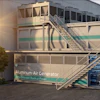
The modular architecture uses containerized units rated at 1 MVA and 40 MWh each. Three units replace a standard 3 MVA diesel generator on a like-for-like basis and scale linearly from edge deployments to hyperscale campuses. The system integrates with both AC- and DC-coupled architectures, supporting retrofit into existing facilities without a complete electrical redesign.
Aluminum fuel is stored in plates on standard warehouse pallets. Because the material is inert in dry form, it requires no specialized conditioning and no fire suppression systems beyond what a standard facility already maintains. The global aluminum supply chain is stable, abundant and fully recyclable, removing the fuel logistics vulnerability that diesel operators accept as routine.
Validation programs in North America are advancing with industry-leading support. The Net Zero Innovation Hub for Data Centers, a consortium that includes Google, Microsoft, AWS, Schneider Electric, Vertiv, APL, Danfoss and Data4, is actively collaborating to validate the AAG in commercial data center configurations, with validation targeted for completion by the end of 2026.
Phinergy has also partnered with Rosendin Electric as its launch installation partner, and the two organizations have collaborated on a white paper that outlines the deployment pathway from pilot to fleet-scale rollout.
A Practical Path Forward
Diesel generators have dominated backup power not because they represent the best solution, but because no viable alternative could match their reliability for long-duration needs. The AAG closes that gap by meeting the combined requirements of reliability, sustainability and cost that other alternatives have consistently failed to deliver together.
For engineers and operations leaders evaluating backup power strategy, now is the time to examine the AAG as a direct diesel replacement. The supply chain is in place, the technology has been proven through commercial pilots in Europe, and U.S. data center validation programs are on track for completion by the end of 2026.
 Emmanuel Levy, CEO, PhinergyPhinergy
Earlier in his tenure at Phinergy, he played a central role in advancing the technology from development to commercial deployment and building relationships across the industry ecosystem. Before Phinergy, he was a senior consultant at OC&C Strategy Consultants in Paris, advising clients across the energy, defense, and consumer goods sectors. He holds an MBA from ESCP Europe and studied Law and International Economics at the Sorbonne.