Walk into a modern manufacturing facility and you’ll see a well-orchestrated mix of robotics, predictive maintenance systems and real-time analytics driving production at scale.
What’s harder to see – but just as vital – is how the movement of physical goods still suffers from blind spots. Pallets disappear into unmonitored zones. Tools are misplaced and rediscovered hours later. Shipments get delayed because the right part ended up in the wrong location.
These aren’t edge cases, they’re daily realities in environments where asset tracking hasn’t kept pace with everything else Industry 4.0 has automated. And the issue isn’t the absence of technology. It’s the lack of Internet of Things (IoT) infrastructure that works in the background.
Without that infrastructure, manufacturers are forced to build workarounds – manual scans, redundant inventory, excess buffers – to compensate for what they can’t see.
Ambient IoT: Automated Visibility That Happens in the Background
The industrial sector has no shortage of tracking options, but each comes with tradeoffs. Barcodes are inexpensive and ubiquitous but require manual scanning at every handoff. RFID systems automate scanning, but only at fixed gate points that are expensive to install and limited in coverage.
Ultra-wideband (UWB) tags offer highly accurate location data but are cost-prohibitive at scale, sometimes reaching $50 to $70 per tag. Long-range wireless protocols like LoRa can cover wider areas, but lack the spatial precision needed for indoor environments where knowing which zone, shelf or workstation an item is in truly matters.
Each of these technologies solves part of the problem. But none were designed for a factory where every asset – from a pallet to a power tool – needs to be visible continuously, passively and without relying on human input.
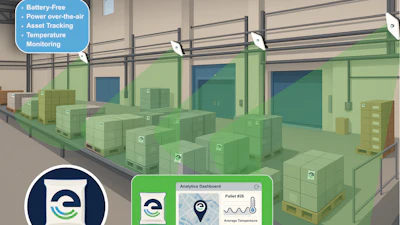
Ambient IoT offers a fundamentally different approach – one that doesn’t add steps to the process but removes them entirely. Instead of scanning or checking in, low-cost Bluetooth Low Energy (BLE) tags can transmit data continuously as they’re powered by a wireless power network (WPN).
These tags don’t need batteries. They harvest energy from fixed WPN bridges placed across a facility, enabling location and sensor data to flow in real time with zone-level precision. Because the network is wireless, tags can be placed virtually anywhere – on crates, bins, tools and pallets.
The result is ambient and autonomous visibility where assets don’t just appear at the beginning and end of a workflow – they remain visible throughout. This kind of passive, persistent awareness is the next logical step in industrial automation. It’s what happens when visibility becomes part of the infrastructure, not an add-on to it.
Infrastructure That Matches the Pace of Manufacturing
In manufacturing, automation is only as effective as its most analog process. For many facilities, that’s still asset tracking. Even the most digitized operations may rely on a mix of spreadsheets, sporadic scans and employee memory to manage where things are.
Ambient IoT eliminates that overhead. In early deployments across sectors like steel manufacturing, toy production and warehouse operations, wirelessly powered BLE tags have enabled manufacturers to track pallets, parts and mobile equipment as they move through each phase – without modifying existing workflows.
And because tags are priced competitively, they’re cost-effective even at high volumes. This opens the door to tracking assets that were previously invisible to digital systems. It delivers zone-level precision – often within 10 to 15 inches – at a tag cost that supports large-scale deployment.
That alone is a breakthrough. Battery replacement cycles are one of the most persistent pain points in industrial IoT. When every node needs attention every few months, scale becomes a liability. Battery-free tags shift the model from upkeep to autonomy.
The Last Mile of Industrial Automation
Industry 4.0 has never been just about robots and sensors – it’s about designing systems that optimize themselves. But without always-on, infrastructure-level asset intelligence, even the smartest systems can stall. Decisions are only as good as the data they’re built on – and partial data leads to partial performance.
Ambient IoT fills that gap. It doesn’t demand more from the user. No scans. No battery swaps. No pauses. Just a steady stream of location and condition data that flows in the background. And when asset movement is tracked continuously, patterns start to emerge.
Facilities can identify tools that routinely end up in the wrong zone, materials that sit too long between steps and equipment that never gets returned to inventory. With the right visibility, these friction points become fixable.
That’s a shift in how industrial intelligence gets built. For years, we’ve focused on digitizing operations. Now, the opportunity is to make that digitization ambient. The factories that invest in this foundational layer today gain the ability to see, adapt and respond in ways that turn operational awareness into competitive advantage.