In a recent Industrial Media poll, manufacturing and engineering professionals were asked, “Which manufacturing jobs are most likely to be replaced by AI and automation?”
Within 24 hours, responses revealed some clear trends. Of 10 selectable options, production planners and schedulers led the results at 37%, followed by machine operators at 18%, and both assemblers and executives at 12% each.
 Industrial Media's polling results by percentage.Industrial Media
These figures suggest that certain positions may face greater disruption than others. However, to understand the full picture, it’s important to look beyond the numbers, examining what AI and automation can actually do and which roles still rely on the irreplaceable human touch.
For production planners and schedulers, data indicates that manufacturing may be reaching an inflection point. According to a January 2025 McKinsey & Company report, AI integration across global manufacturers could unlock $4.4 trillion in productivity value over the next decade. Yet, despite widespread investment, only 1% of companies consider themselves to have achieved AI maturity.
Similarly, a Deloitte survey from May 2025 found that just 29% of manufacturers have scaled AI at the network or plant level. This suggests that rather than replacing production planners, AI is redefining how they operate, enabling them to rewrite the production-planning playbook.
As Carlos Gonzalez de Villaumbrosia, founder and CEO of AI training firm Product School, wrote in a November 2025 blog, “In practice, AI is more of a super-smart assistant than a substitute.” AI can relieve production planners of repetitive tasks like manual data entry, predefined scheduling and inventory tracking, allowing them to focus on higher-level decision-making and optimization.
But where does this leave more hands-on roles, such as machine operators and assemblers?
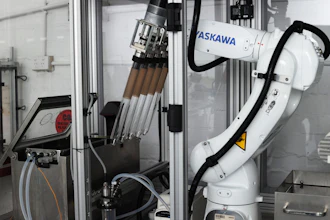
A 2019 Oxford Economics study estimated that by 2030, up to 20 million manufacturing jobs could be lost to robotics. Yet in the years since, the reality has been more nuanced. While robotics adoption has surged, with more than 4 million industrial robots operating globally as of September 2024, most are still limited to repetitive, predictable tasks that require minimal human judgment.
Automation thrives in environments that are hazardous or monotonous, where consistency and safety take precedence. But it’s clear that these technologies form only part of the equation.
Instead of wholesale job elimination, manufacturing is undergoing a transformation. New roles such as robotic maintenance technicians and AI system supervisors are emerging, while existing employees are being upskilled or redeployed into these evolving functions.
This balance underscores the enduring importance of human capability. Skills like creativity, troubleshooting, adaptability and problem-solving remain beyond the reach of machines. AI and automation can enhance production, but they cannot yet replicate the implicit, critical thinking that drives innovation and progress.
As AI continues to shape the manufacturing landscape, it’s less about replacement and more about redefinition. Robotics may streamline efficiency, but human ingenuity will remain the cornerstone of progress. The future factory will likely be one where humans and machines work side by side, each doing what they do best.