A cacophony of loud noises, brought on by the constant rhythm of heavy machinery, power tools, trucks, bulldozers, and inbound and outbound traffic, is the sound of a large commercial construction site. It may be symphonic to the ears of general contractors and those awaiting the final ribbon-cutting ceremony, but along the way, the site presents a jigsaw puzzle of man and machines, all of which must be tightly choreographed to meet schedules, safety standards, and budget estimates.
Currently underway in the U.S., large-scale construction projects range from multi-billion-dollar megaprojects to smaller renovation or expansion projects. According to Modor Intelligence, the U.S. commercial construction market is estimated to reach $567.05 billion in 2025 and grow to $695.01 billion by 2030. This CAGR of 4.15% is being driven by Federal spending authorized in the Infrastructure and Jobs Act and is complemented by private investments in new warehouses, fulfillment facilities, data centers, and commercial building retrofits.
All of these projects are complex job sites requiring tightly managed logistics, particularly to ensure that inbound and outbound traffic functions smoothly to avoid gridlock on site. Many projects are now utilizing management software powered by AI algorithms to provide a path for strengthening numerous processes and making them transparent to all entities involved, particularly in yard management activities – the backbone of construction success in meeting budget and regulatory requirements.
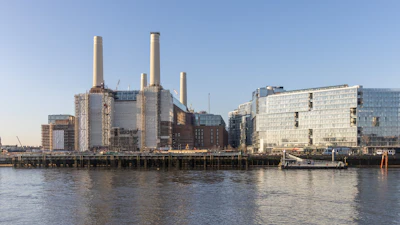
A massive construction project in the UK, which required retrofitting a 1927 defunct power station into a multi-use residential and commercial destination, embraced AI to create a yard management nerve center, resulting in an award-winning development.
 The Battersea project.Inform
Retrofitting a Power Station into a Multi-Use Riverside Destination
In the heart of London, on the River Thames, the aging 42-acre Battersea Power Station was decommissioned in the early 1980s. The historical Art Deco building remained in situ until 2019, when secured funding allowed its transformation into a complex mixed-use destination featuring retail, residential, office, leisure, and cultural spaces.
The $12 billion megaproject, which opened in 2022, was structured into eight phases, each designed by a world-renowned architect guided by an overarching strategy across all phases. A key concern for the project was how to mitigate the project’s impact on London traffic. Known by some as the most congested city in Europe, construction site operators looked to Inform’s Syncrosupply platform to handle inbound and outbound traffic, drop-off assignments, route planning, and even documentation of CO2 emissions from construction site transports.
Yard Management and Time Slot Management Made Simple
The Inform platform was selected for its ability to transcend construction deliverables into an overall operating campus that enabled onsite contractors to match lifts, hoists, and cranes to each delivery and review the optimization of each resource to ensure maximum productivity with the least amount of gridlock. Syncrosupply features intelligent decision-making algorithms based on Operations Research that can continuously optimize business processes within seconds.
At the Battersea site, time slot management allowed forwarding agents to book delivery time slots via a central online portal, giving dispatchers complete transparency on which trucks would arrive when and where, and the utilization capacity for onsite resources to unload at specific times. Even the ever-changing weekly updated construction site plan was integrated into the platform. With an integrated network editor, planners were able to independently add or disable loading points at any time. Therefore, time slots could be allocated in synch with the availability of resources, for example, freight elevators or cranes, each of which had its status recorded in the system.
 A massive construction project in the UK, which required retrofitting a 1927 defunct power station into a multi-use residential and commercial destination, embraced AI to create a yard management nerve center, resulting in an award-winning development.Inform, Matthias Wurst
Focus on Logistics Optimization at the Battersea Power Project
Yard management logistics optimization was one of the most important tasks for the software to achieve. It used the software to streamline gate utilization, loading points, and resources needed to manage the initially 400 trucks operating on site daily. The planning software managed the gates, loading points, and resources to synchronize deliveries and outbound trucking to avoid traffic jams.
Like other complicated construction sites, the layout at Battersea changed every week as construction progressed. Previously, a manual system only tracked delivery traffic up to the gate. It was not possible to identify if a specific loading point on the construction site was occupied or whether the right resources, such as cranes, elevators, or other construction site equipment, were available at the time of arrival to unload. With the enormous number of daily deliveries and the distribution of responsibilities among the various construction companies, the individual schedulers could no longer manually monitor whether it made sense to deliver a truck at a specific time, what freight was needed where, or expected throughput times.
The Battersea project was completed in 2022. Lauded by the community, it also garnered a Supply Chain Excellence Award in 2020, with judges commenting that it was a “good, well thought out project” with “tight brief, measurable benefits case and delivered to expectations.” Syncrosupply proved to be a powerful tool that was a significant partner in virtually eliminating onsite delays and significantly improving the flow of traffic and materials to the points of use, and created a scalable platform for future development.
Yard Management is the Nerve Center of a Complex Construction Project
To reach its full potential, a modern yard management system applies intelligent optimization made possible by AI-driven algorithms that recalculate schedules in real time when disruptions occur, such as delays or last-minute changes. With a high degree of automation, it continuously analyzes data from transportation, storage, and production systems that recognize real-time yard conditions and dynamic priorities in order to manage the entire delivery process.
Tasks such as assigning docks, coordinating the trailer yard, and managing buffer zones are guided by data-driven, predictive, and situationally aware decision-making. As a result, the smart yard management platform evolves from a passive control tool into an active, intelligent partner that accelerates workflows, maximizes resource use, and ensures long-term process stability.
 Inform