When scientists make the thin metal films used in electronics, optics, and quantum technologies, they usually spend months tinkering with the temperature, composition and timing of the process, hoping to land on just the right recipe. Now, researchers at the University of Chicago Pritzker School of Molecular Engineering (UChicago PME) have built a “self-driving” lab system that does this work on its own, using robotics and artificial intelligence to decide the next best step without waiting for a human.
Yuanlong Bill Zheng, an undergraduate who is now a UChicago PME PhD student, said, “We wanted to free researchers from the tedious, repetitive labor of setting up and tweaking these experiments. Our system automates the entire loop—running experiments, measuring the results, and then feeding those results back into a machine-learning model that guides the next attempt.”
Fine-tuning vapor deposition
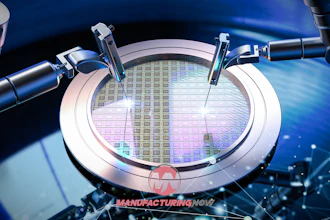
The new system revolves around a process known as physical vapor deposition (PVD) in which a material such as silver is heated until it vaporizes, and then condenses into an ultra-thin layer on a surface. PVD is highly sensitive to many variables—temperature, time, materials, and small differences in the surrounding environment—and so predicting the outcome of experiments has been tricky.
Moreover, researchers have traditionally adjusted these parameters by hand, running countless trial-and-error cycles, each taking a day or more. Zheng, in collaboration with UChicago undergraduates Connor Blake and Layla Mravae, wanted to make this process faster and easier to predict.
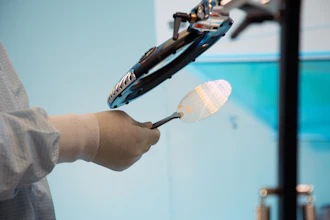
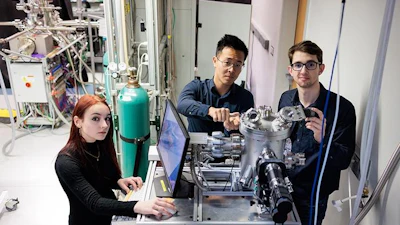
The team began by assembling from scratch a robotic system that could carry out each step of the PVD process, from handling samples to measuring the properties of a film after it is made. Then, they collaborated with Dr. Yuxin Chen and his student Fengxue Zhang from UChicago’s Computer Science Department, and programmed a machine learning algorithm to predict what parameters are needed for any desired thin film, synthesize and analyze the resulting product, and tweak the parameters until it works.
“A researcher can tell the model what they want to come out at the end, and the machine learning model will guide the system through a sequence of experiments to achieve it,” said Zheng.
To account for unpredictable quirks—such as subtle differences between substrates or trace amount of gases in the vacuum chamber—the system also begins each new experiment by creating a very thin “calibration layer” of film that helps the algorithm read the unique conditions of each run.
Zheng said, “Researchers have long struggled with irreproducibility in physical vapor deposition, where tiny variations in hidden variables make it hard to get the same result twice. Those inconsistencies end up in the training data as noise and can be detrimental for the machine learning model. Our high-throughput automated setup captured these variations in a systematic, quantitative way.”
Faster, easier, and cheaper material synthesis
To test their approach, the researchers asked the system to grow silver films with specific optical properties—an ideal proof of principle since silver is a simple, well-understood material but still tricky to perfect. The self-driving setup hit the desired targets in an average of 2.3 attempts. In total, the machine explored the full range of experimental conditions in a few dozen runs—something that would normally take a human team weeks of late-night work.
In all, the setup cost less then $100,000 for the undergraduate team to build from scratch—an order of magnitude cheaper than previous attempts by commercial labs to build self-driving systems for film synthesis.
With this foundation, the team hopes to expand the method to more complex materials, including those used in next-generation electronics and quantum devices.
“This is just a prototype, but it shows how AI and robotics can transform not only how we make thin films, but how we approach materials discovery across the board,” said Yang.