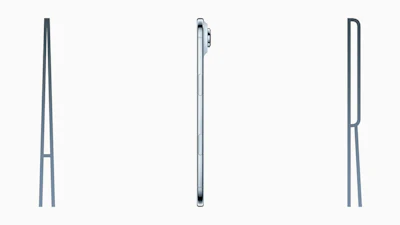
Most reviews of Apple’s new iPhone Air celebrated its lightweight frame and aerospace-inspired materials, but one small detail is sparking larger conversations in the manufacturing community: the titanium USB-C port. This port was not machined like the previous iPhones; it was 3D printed.
For the average consumer, additive manufacturing (AM) making it into mainstream products might not seem like a big deal, but for manufacturers, this is confirmation that AM has finally crossed the threshold. What was once a niche technology for prototypes and quick, in-the-field repairs is now giving one of the most recognizable consumer products a competitive edge.
Additive is no longer a backup plan; it’s turning into a must-have for modern production environments. From aerospace to medical to automotive to consumer electronics, manufacturers are adopting AM because it gives them faster iterations, lighter parts, and the freedom to design without the constraints of tooling. The question isn’t if your operation should adopt it, but how to do so effectively without the pain of retooling or disrupting existing workflows.
A tool-less revolution
Traditional manufacturing depends heavily on tooling. Every new mold, die, or fixture comes with lead times, costs, and inevitable retooling when designs evolve. Additive manufacturing breaks that cycle. By building components directly from digital files, layer by layer, AM eliminates the need for tooling altogether.
This “tool-less” nature means manufacturers can iterate faster, experiment more, and bring products to market with far less lead time. Design changes that once triggered weeks of retooling can now be executed overnight.
Solving legacy and spare part challenges
One of the most practical uses of AM lies in solving supply chain bottlenecks, especially when legacy methods and tooling no longer exist. In industries like transportation, where equipment lifespans stretch across decades, missing or damaged tooling can halt production or force expensive reverse engineering.
Additive manufacturing provides a direct solution. By scanning an existing component and printing replacements on demand, manufacturers can restore uptime without retooling or long supplier lead times. For instance, a large automotive manufacturer leveraged metal additive systems to reproduce discontinued spare parts and tooling inserts, reducing downtime and warehouse inventory while maintaining service for older product lines. The same digital workflow is now enabling low-volume runs for specialized components that were once economically unfeasible.
How to start without major retooling
While introducing AM might seem like a daunting task for small or legacy shops, it doesn’t actually require a major overhaul; it simply needs a strategic entry point.
The most successful implementations begin with low-risk, high-impact use cases like jigs, fixtures, clamps, or assembly aids. These are often unique or low-volume parts that are ideal for additive processes. A composite fixture printed overnight can replace a machined counterpart that once took weeks, saving time and freeing up skilled labor for higher-value tasks.
Starting with polymer-based 3D printing is another smart move. It’s cost-effective, mature, and well-suited for learning the workflows of additive manufacturing. As experience grows, teams can expand into metal AM or hybrid approaches that combine additive and subtractive technologies for greater flexibility.
Hybrid manufacturing, where a printed near-net-shape part is finished with CNC machining, is an especially powerful bridge between the traditional and the digital. It allows manufacturers to get the best of both worlds: the design freedom of AM with the precision and surface quality of conventional processes.
The digital skillset advantage
As AM adoption increases, one truth becomes clear: success depends as much on mindset as on machinery. Because additive manufacturing is a digital-first process, developing the right software and simulation expertise is critical.
Simulation is key not only for manufacturing, but even for quoting. By virtually testing a build before production, manufacturers can assess risk, predict cost, and ensure quality outcomes before hitting print.
These digital capabilities also enable stronger quality assurance. Integrated inspection software can validate parts against design intent immediately after printing, ensuring every component meets the same standards as traditionally machined ones.
Real-world results in action
Across industries, the impact of AM is tangible. A major aerospace supplier, for example, used digital process simulation to redesign a structural bracket, achieving a 40% weight reduction that translates into measurable CO₂ savings over the component’s lifecycle.
Another manufacturer integrated 3D-printed tooling into its injection molding operations, cutting lead times from six weeks to just ten days while maintaining performance and durability. By simulating the AM tooling in advance, they eliminated trial-and-error rework and improved throughput across the production line.
Tips for implementation
- Start small, think big. Choose a single use case, like fixtures or replacement tooling, that demonstrates immediate ROI.
- Leverage simulation early. Process simulation reduces print failures, improves repeatability, and accelerates certification.
- Build digital fluency. Invest in CAD, DfAM (Design for Additive Manufacturing), and quality inspection software skills.
- Focus on materials. Master one material family before expanding to others.
- Partner wisely. Collaborate with technology providers experienced in both hardware and software integration.
The bottom line
Additive manufacturing is no longer the “future” of production; it’s the new foundation. Its ability to eliminate tooling, enable localized production, and bridge design with manufacturing makes it a strategic advantage for companies facing constant change.
Whether it’s printing aerospace components or automotive fixtures, the message is the same: AM isn’t replacing traditional methods, it’s enhancing them. And the manufacturers who embrace it now will define the next generation of what’s possible.
Mathieu Perennou is the Director of Business Development at Hexagon Manufacturing Intelligence