AI, power bottlenecks and labor constraints are forcing a ground‑up rethink of data center infrastructure for 2026 and beyond. With global power demand expected to increase by around 50% by 2027 and as much as 165% by 2030 due to AI acceleration and cloud growth, the industry must move from incremental optimization to fundamental redesign (and most likely sooner than we think). What used to be a question of adding more racks or refreshing servers has become a systems‑level challenge that touches grid connections, voltage levels, cooling strategies and the physical interfaces that tie everything together.
At the same time, this surge is arriving in an environment where qualified labor is increasingly scarce, and deployment timelines are shrinking. Operators need to support denser, higher‑power racks while relying on smaller on‑site teams, making traditional, labor‑intensive wiring and one‑off builds more difficult to sustain. The result is a shift toward modular, connectorized and factory‑assembled solutions that can be installed quickly, repeated across sites and maintained safely without such deep specialization.
These pressures are converging into a new set of priorities for AI‑ready data centers. Power delivery is moving toward higher‑voltage, higher‑efficiency architectures; racks are being reimagined to offload power equipment into sidecars; and cross‑industry innovations from automotive, industrial and telecom are being adapted to meet hyperscale and evolving enterprise AI needs. Collectively, these changes are redefining the expectations for how data centers will be engineered in the coming years.
AI Workloads as the New Design Point
AI workloads are now the baseline for new facilities, with training and inference jobs driving extreme power densities, highly variable load profiles, and demanding availability requirements that dictate how sites are planned, powered, and cooled. Instead of designing for a mix of modest, relatively steady enterprise applications, engineers now have to assume GPU‑heavy clusters, rapidly growing model sizes, and continuous hardware refresh cycles as the norm.
That shift is reshaping both the physical and operational model of data centers. Facilities built around traditional “scale up” and “scale out” patterns are being supplemented by architectures that distribute AI workloads across multiple sites, edge locations and regions. As operators push toward this more distributed, AI‑first footprint, every design choice — from voltage levels and connector systems to how quickly racks can be installed and serviced — must support higher power, greater flexibility and faster deployment than legacy environments were ever expected to handle.
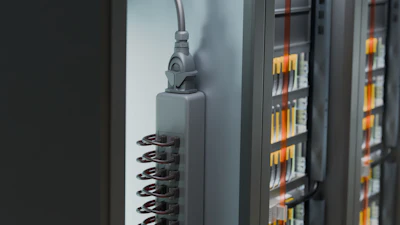
 Also known as power cables or busbars, data center power whips are crucial components for power distribution.Harting
Scaling Up, Out & Across
Historically, data centers grew by scaling up individual servers and scaling out rows of racks inside a single facility. Still, AI is pushing operators to think in three dimensions at once. Scale up still matters — packing more GPUs and accelerators into each node — but it is now paired with scale out across dense rows and, increasingly, scale across multiple sites that share workloads in near real time. This third dimension shifts the focus from optimizing a single site to orchestrating capacity, resilience and latency across an entire fleet of locations that collectively deliver the performance AI requires.
That multi‑site reality has direct implications for infrastructure. Higher average rack power, more dynamic load shifts between regions, and tighter latency requirements all raise the stakes for power delivery, standardization, and serviceability. Connectors, cabling, and rack layouts need to be repeatable across locations so operators can deploy new capacity quickly, move workloads to where power and cooling are available, and maintain consistent reliability even as individual sites evolve at different timelines.
Power as the New Bottleneck
Power has become the defining constraint for AI‑era data centers, eclipsing floor space and even compute capacity in many planning conversations. Traditional facilities were designed around racks drawing 7–10 kW, but AI‑capable racks are increasingly landing in the 30–100+ kW range, with dedicated AI halls averaging 60 kW or more per rack. That density stresses upstream utility connections, on‑site distribution gear, conductor sizing, and thermal envelopes, forcing engineers to revisit assumptions held for legacy 7-10kW racks. Simply “adding more power” is no longer feasible when grid interconnection delays, higher costs, and significant thermal management challenges accompany each incremental megawatt.
These realities are accelerating the move toward higher‑voltage, higher‑efficiency architectures such as ±400 VDC or 800 VDC distribution. By reducing the number of power conversion stages, these systems can cut losses, shrink equipment footprints, and free up space for computation in already-constrained white space. For engineers, that means treating power distribution as a first‑order design problem: conductor geometry, connector selection and protection schemes must all be reconsidered to safely handle higher voltages and currents while maintaining the serviceability and uptime that AI workloads demand.
Labor Shortages & the Push for Modularity
As power and density rise, the industry is also grappling with an acute shortage of skilled labor to build and operate these facilities. More than half of global data center operators struggle to find qualified workers, and some analyses suggest hundreds of thousands of additional construction and technical staff will be needed over the next few years just to meet planned capacity. Electricians, mechanical trades and specialized commissioning teams are in particularly short supply, leading to project delays, rising costs and increased risk when schedules compress.
In response, developers and operators are leaning into modular, factory‑built approaches that shift complexity off‑site. Pre‑engineered power skids, connectorized cable assemblies, and rack‑level power modules allow more detailed work to be completed in controlled manufacturing environments and less to be improvised in the field. Plug‑and‑play interfaces reduce the amount of on‑site terminations that require highly skilled electricians, while standardized modules can be replicated across multiple locations to accelerate “scale across” strategies. This move toward modularity is becoming one of the few viable ways to reconcile AI’s aggressive power roadmaps with a constrained workforce, reducing schedule risk while maintaining safety and quality at scale.
Cross‑Industry Innovation in Power & Cooling
Data centers are increasingly looking beyond their own walls for answers to AI’s power and thermal challenges. Automotive and e‑mobility programs are advancing high‑voltage architectures and liquid‑cooled conductors that closely mirror what AI “factories” now require: compact, efficient power delivery at hundreds of volts and thousands of amps, with tightly managed temperatures along every link in the chain. The telecom and industrial sectors contribute decades of experience in DC distribution, ruggedized connectors, and serviceable, modular designs, offering solutions that can be adapted to hyperscale environments where uptime and safety are non‑negotiable.
As these disciplines intersect, the blueprint for next‑generation AI data centers is starting to crystallize. Facilities are moving toward higher‑voltage backbones, connectorized power paths and modular building blocks that can be repeated across regions and refreshed as technology evolves. At the same time, the sector is recognizing that no single industry, vendor or standard will solve the problem alone; progress will depend on tight collaboration between chip designers, integrators, utilities, equipment manufacturers and the engineering teams that keep plants and data centers running.
Designing Distributed, High‑Density Data Centers for the Next Decade
By combining advances in power electronics, cooling, and connectivity across multiple domains, operators can build an AI infrastructure that scales not only in 2026 but also through the next wave of innovation. The data center stops being a static utility in the background. It becomes a continuously evolving platform, where each generation of design can build on the last instead of starting from scratch.
For engineers, that shift is both a challenge and an opportunity. It demands closer collaboration with utilities, equipment makers and adjacent industries. Still, it also opens the door to architectures that are more efficient, resilient, and adaptable than anything that came before. In an AI‑first world, the facilities that can integrate these cross‑industry lessons fastest will be the ones that set the pace for what is possible.